Countries That Accept Apostilles: Complete Guide to Hague Convention Countries
If you plan to use official documents abroad, one of the most important questions to answer is whether the destination country accepts apostilles (Countries That Accept Apostilles).
An apostille is an internationally recognized certification that simplifies the authentication of public documents between countries that are members of the Hague Apostille Convention. Understanding which countries accept apostilles can help you avoid delays, rejected applications, and unnecessary legalization procedures.
Whether you are preparing documents for immigration, international business, study abroad, marriage overseas, or dual citizenship, verifying apostille acceptance should be one of your first steps.
What Is an Apostille?
An apostille is an official certificate issued under the Hague Convention of 5 October 1961.
It verifies:
- The authenticity of a signature
- The authority of the person signing the document
- The validity of an official seal or stamp
Once an apostille is attached, the document can generally be accepted in other member countries without additional legalization.
Why Do Countries Accept Apostilles?
Before the Hague Apostille Convention, documents often had to go through lengthy legalization procedures involving multiple government agencies and foreign embassies.
The Convention simplified this process by creating a standardized certification system recognized among participating countries.
As a result, apostilles make international document recognition faster, easier, and more cost-effective.
Which Countries Accept Apostilles?
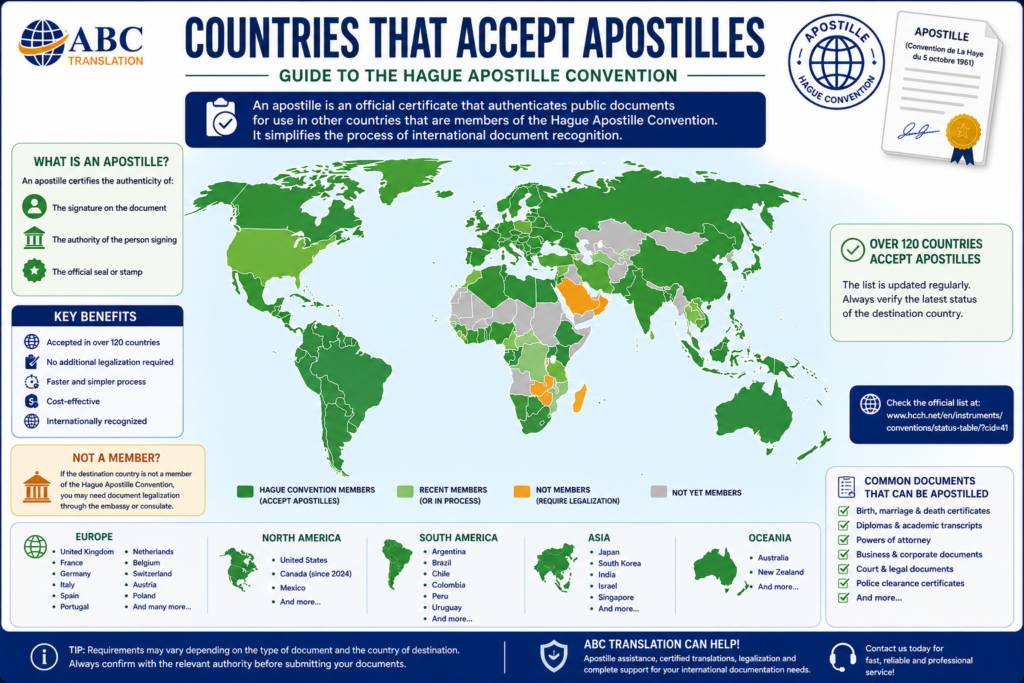
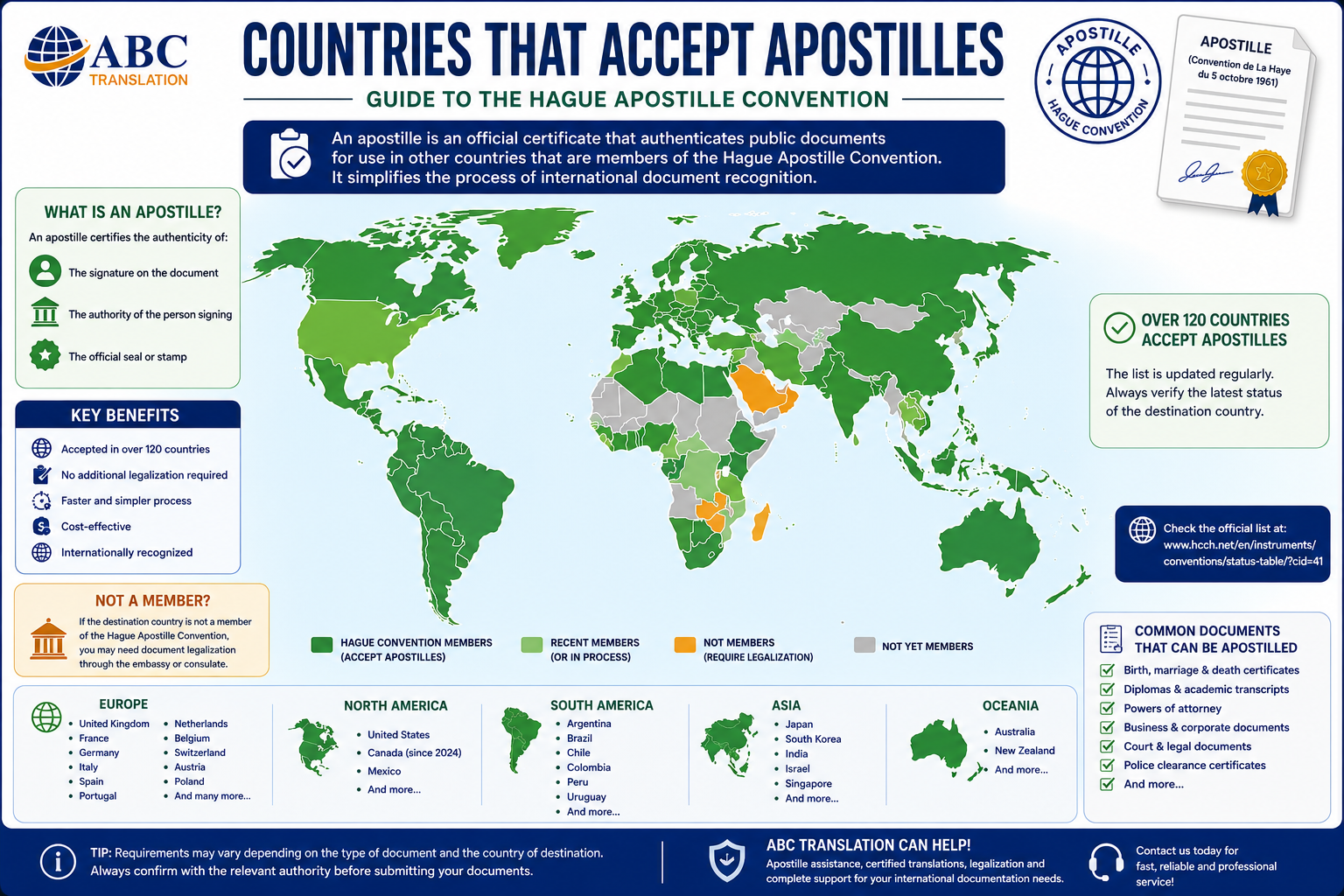
Countries that accept apostilles are those that are members of the Hague Apostille Convention.
Today, more than 120 countries and territories recognize apostilles.
Europe
Many European countries accept apostilles, including:
- United Kingdom
- France
- Germany
- Italy
- Spain
- Portugal
- Switzerland
- Netherlands
- Belgium
- Austria
- Poland
North America
- United States
- Canada
- Mexico
South America
- Argentina
- Brazil
- Chile
- Colombia
- Peru
- Uruguay
Asia
- Japan
- South Korea
- India
- Israel
- Singapore
Oceania
- Australia
- New Zealand
Because membership can change over time, it is always advisable to verify the latest status of the destination country before submitting documents.
How to Check Whether a Country Accepts Apostilles
Before obtaining an apostille, confirm that the destination country:
- Is a member of the Hague Apostille Convention
- Recognizes apostilles for your document type
- Does not require additional certifications
- Accepts accompanying translations if necessary
Country-specific requirements may vary depending on the purpose of the document.
Common Documents Used in Apostille Countries
Apostilles are commonly required for:
Immigration Documents
- Birth certificates
- Police clearance certificates
- Marriage certificates
- Divorce decrees
Educational Documents
- Diplomas
- Degrees
- Academic transcripts
- Enrollment certificates
Employment Documents
- Professional licenses
- Background checks
- Employment records
Business Documents
- Articles of incorporation
- Corporate resolutions
- Commercial contracts
- Business registrations
Personal Legal Documents
- Powers of attorney
- Affidavits
- Notarized declarations
When Is an Apostille Sufficient?
For Hague Convention countries, an apostille is usually enough to authenticate a document.
Common situations include:
Studying Abroad
Universities may require apostilled diplomas and transcripts.
Working Abroad
Employers often request apostilled educational and professional documents.
Marriage Abroad
Foreign civil registries may require apostilled birth and marital status certificates.
Dual Citizenship Applications
Citizenship authorities frequently request apostilled civil documents.
International Business
Companies often use apostilled corporate documents when operating internationally.
What If a Country Does Not Accept Apostilles?
If the destination country is not a member of the Hague Apostille Convention, an apostille alone may not be sufficient.
Instead, you may need document legalization.
Legalization typically involves:
- Government authentication
- Foreign affairs certification
- Embassy or consulate legalization
This process is generally more complex and time-consuming than obtaining an apostille.
Do Apostilled Documents Need Translation?
Often, yes.
Many foreign authorities require:
- Certified translations
- Sworn translations
- Official translations
The apostille confirms the document’s authenticity, while the translation ensures that local authorities can understand its contents.
Common Mistakes to Avoid
Many applicants experience delays because they:
- Assume all countries accept apostilles
- Fail to verify destination-country requirements
- Ignore translation requirements
- Submit uncertified copies
- Confuse apostille and legalization procedures
Checking requirements before submission can save significant time and expense.
Why It Is Important to Verify Destination Country Requirements
Even among Hague Convention members, specific document requirements can vary.
Before proceeding, always confirm:
✓ Apostille acceptance
✓ Document eligibility
✓ Translation requirements
✓ Submission procedures
✓ Processing timelines
Proper preparation helps ensure your documents are accepted the first time.
How ABC Translation Can Help
ABC Translation assists individuals and businesses with international document preparation.
Our services include:
- Apostille assistance
- Certified translations
- Sworn translations
- Document legalization
- Notarial support
- International document preparation
Whether your documents are intended for immigration, education, employment, marriage, citizenship, or business, we can help ensure they meet all applicable requirements.
FAQ
Which countries accept apostilles?
Countries that are members of the Hague Apostille Convention generally accept apostilled documents.
Does the United States accept apostilles?
Yes. The United States is a member of the Hague Apostille Convention and recognizes apostilled documents.
Does Canada accept apostilles?
Yes. Canada joined the Hague Apostille Convention and began issuing and accepting apostilles in 2024.
What if a country does not accept apostilles?
You will typically need document legalization through government authorities and the destination country’s embassy or consulate.
Does an apostille translate a document?
No. An apostille certifies authenticity but does not translate the document’s content.