Countries Requiring Legalization Instead of Apostille: Complete Guide
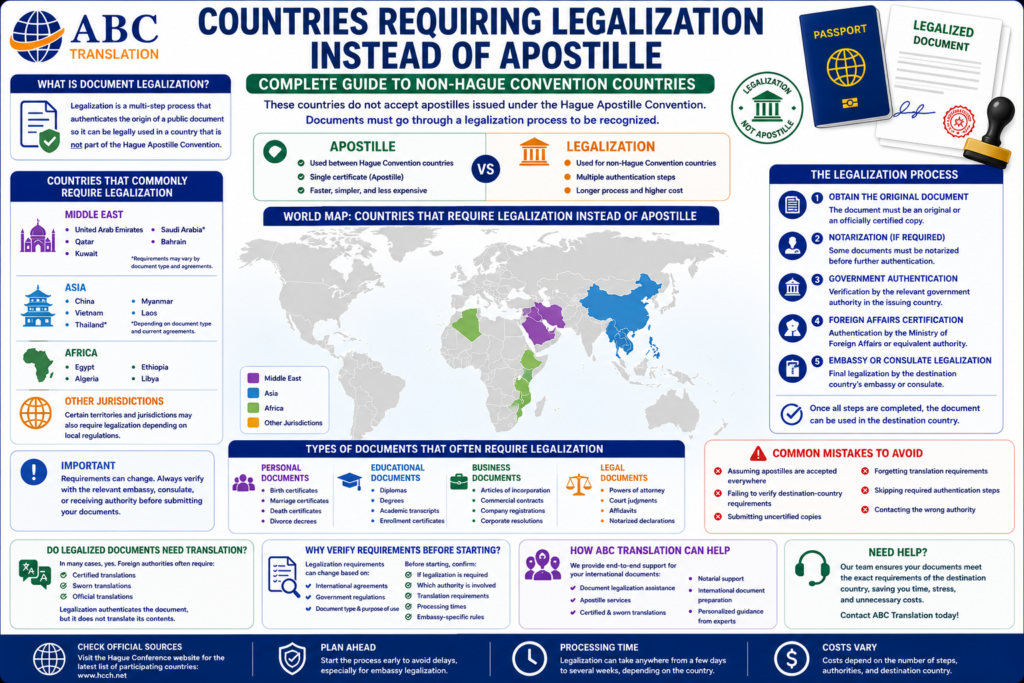
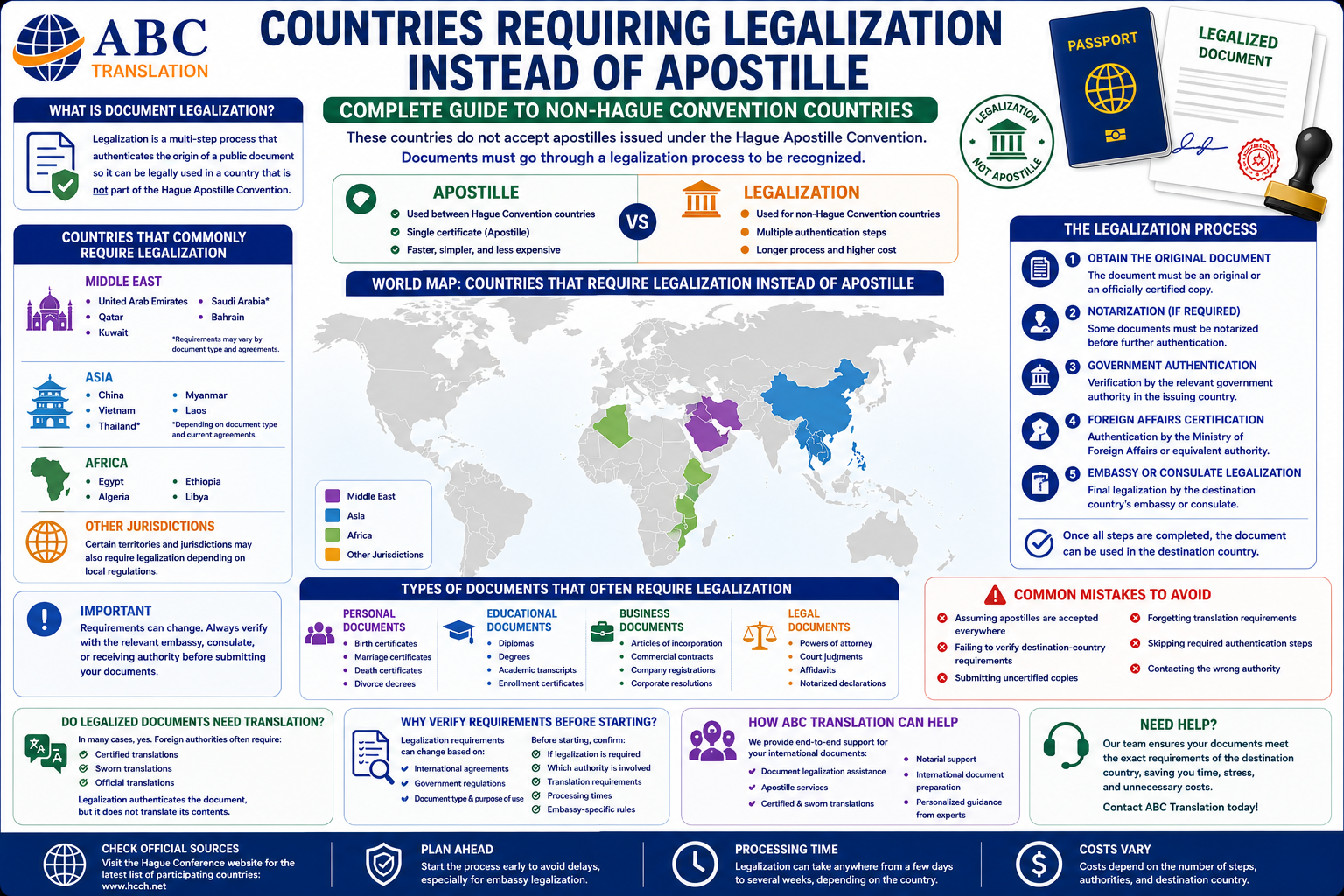
If you need to use official documents abroad, one of the most important factors to consider is whether the destination country accepts apostilles or requires document legalization (Countries Requiring Legalization Instead of Apostille).
While more than 120 countries recognize apostilles under the Hague Apostille Convention, many countries still require a more complex authentication process known as legalization. Understanding the difference between apostille and legalization can save significant time, reduce delays, and help ensure that your documents are accepted by foreign authorities.
Whether you are applying for a visa, studying abroad, working internationally, getting married overseas, or conducting business in another country, knowing which countries require legalization instead of an apostille is essential.
What Is Document Legalization?
Document legalization is a process used to verify the authenticity of official documents for use in countries that are not members of the Hague Apostille Convention.
Unlike an apostille, which involves a single certification, legalization often requires multiple levels of authentication.
These may include:
- Notarization
- Government authentication
- Foreign affairs certification
- Embassy or consulate legalization
The exact process depends on both the issuing country and the destination country.
Why Do Some Countries Require Legalization?
Countries that are not members of the Hague Apostille Convention do not recognize apostilles.
As a result, foreign documents must go through additional verification procedures before they can be legally accepted.
Legalization provides assurance that:
- The document is genuine
- The signatures are authentic
- The issuing authority is recognized
- The document can be used legally within the destination country
Which Countries Commonly Require Legalization Instead of Apostille?
Requirements can change over time, so it is always important to verify current regulations.
Countries that have historically required legalization rather than apostille include:
Middle East
- United Arab Emirates
- Qatar
- Kuwait
- Saudi Arabia (requirements may vary by document type and current agreements)
- Bahrain
Asia
- China
- Vietnam
- Thailand (depending on document type and current agreements)
- Myanmar
- Laos
Africa
- Egypt
- Algeria
- Ethiopia
- Libya
Other Jurisdictions
Certain territories and jurisdictions may also require legalization depending on local regulations.
Always verify requirements with the relevant embassy, consulate, or receiving authority before submitting documents.
Apostille vs. Legalization
Apostille
- Used between Hague Convention countries
- Single authentication certificate
- Faster processing
- Lower costs
- Simplified procedure
Legalization
- Used for non-Hague Convention countries
- Multiple authentication stages
- Longer processing times
- Higher costs
- Embassy or consular involvement often required
Choosing the correct process is critical to avoid document rejection.
Documents Commonly Requiring Legalization
Personal Documents
- Birth certificates
- Marriage certificates
- Death certificates
- Divorce decrees
Educational Documents
- Diplomas
- Degrees
- Academic transcripts
- Enrollment certificates
Business Documents
- Articles of incorporation
- Commercial contracts
- Company registrations
- Corporate resolutions
Legal Documents
- Powers of attorney
- Court judgments
- Affidavits
- Notarized declarations
How Does the Legalization Process Work?
The legalization process typically follows several steps.
Step 1: Obtain the Original Document
The document must usually be an original or an officially certified copy.
Step 2: Notarization (If Required)
Some documents must first be notarized before further authentication.
Step 3: Government Authentication
The document may need verification by a competent government authority.
Step 4: Foreign Affairs Certification
Many countries require authentication by the Ministry of Foreign Affairs or equivalent authority.
Step 5: Embassy or Consulate Legalization
The destination country’s embassy or consulate may perform the final legalization.
Only after completing all required stages will the document generally be accepted abroad.
Do Legalized Documents Need Translation?
In many cases, yes.
Foreign authorities often require:
- Certified translations
- Sworn translations
- Official translations
The legalization process authenticates the document, but it does not translate its contents.
Common Mistakes to Avoid
Many applicants encounter delays because they:
- Assume apostilles are accepted everywhere
- Fail to verify destination-country requirements
- Submit uncertified copies
- Forget translation requirements
- Skip required authentication steps
- Contact the wrong authority
Proper preparation can prevent costly delays.
Why Verify Requirements Before Starting?
Legalization requirements can change based on:
- International agreements
- Government regulations
- Document type
- Purpose of use
Before starting the process, always confirm:
✓ Whether legalization is required
✓ Which authority issues certifications
✓ Translation requirements
✓ Processing times
✓ Embassy-specific procedures
Doing so helps avoid unnecessary expenses and processing delays.
How ABC Translation Can Help
ABC Translation assists individuals and businesses with international document authentication.
Our services include:
- Document legalization assistance
- Apostille services
- Certified translations
- Sworn translations
- Notarial support
- International document preparation
Our team helps ensure your documents meet the requirements of the destination country before submission (Countries Requiring Legalization Instead of Apostille).
FAQ
Which countries require legalization instead of an apostille?
Countries that are not members of the Hague Apostille Convention generally require legalization rather than apostille certification.
Does China require legalization?
In some cases requirements depend on current international agreements and document types. Always verify current procedures before submission.
Is legalization more complicated than an apostille?
Yes. Legalization typically involves multiple authentication stages and may require embassy or consular certification.
Can a legalized document be used internationally?
Yes, provided it has completed all required authentication steps for the destination country.
Does legalization replace translation requirements?
No. Legalization authenticates documents but does not translate them.