Apostille vs Notarization
When preparing documents for international use, many people confuse apostilles and notarization (Apostille vs Notarization).
Although both processes help establish document authenticity, they serve different purposes and are performed by different authorities.
Understanding the distinction between apostilles and notarization can help ensure your documents are properly prepared for use abroad.
ABC Translation assists individuals, businesses, legal professionals, and international organizations with apostilles, notarization support, certified translations, and international document preparation.
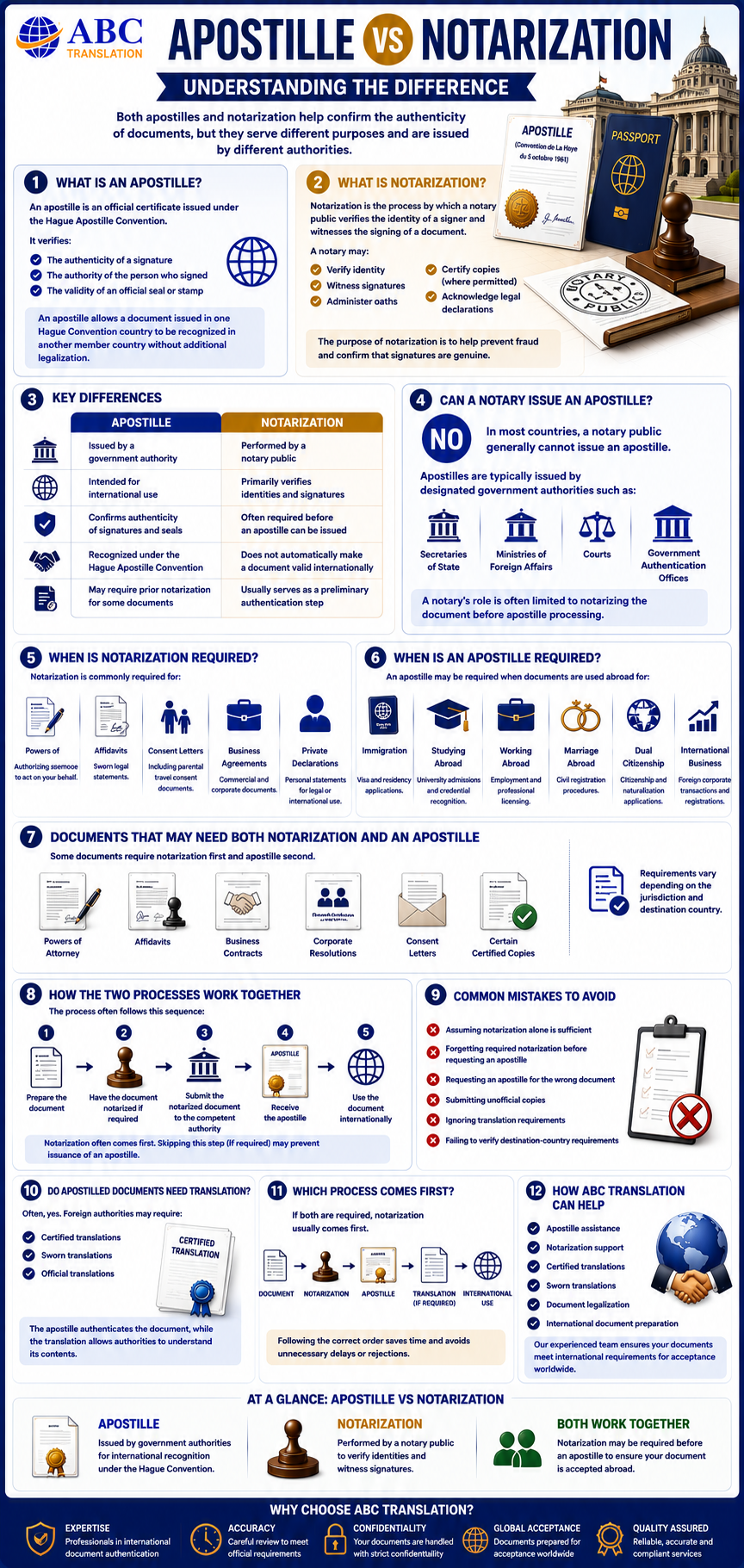
What Is an Apostille?
An apostille is an official certificate issued under the Hague Apostille Convention.
It verifies:
- The authenticity of a signature
- The authority of the person who signed the document
- The validity of an official seal or stamp
An apostille allows a document issued in one Hague Convention country to be recognized in another member country without additional legalization (Apostille vs Notarization).
What Is Notarization?
Notarization is the process by which a notary public verifies the identity of a signer and witnesses the signing of a document.
A notary may:
- Verify identity
- Witness signatures
- Administer oaths
- Certify copies (where permitted)
- Acknowledge legal declarations
The purpose of notarization is to help prevent fraud and confirm that signatures are genuine.
The Main Difference Between Apostille and Notarization
Apostille
- Issued by a government authority
- Intended for international document use
- Confirms authenticity of signatures and seals
- Recognized under the Hague Apostille Convention
- May require prior notarization for some documents
Notarization
- Performed by a notary public
- Primarily verifies identities and signatures
- Often required before an apostille can be issued
- Does not automatically make a document valid internationally
- Usually serves as a preliminary authentication step
Can a Notary Issue an Apostille?
In most countries, no.
A notary public generally cannot issue an apostille.
Apostilles are typically issued by designated government authorities such as:
- Secretaries of State
- Ministries of Foreign Affairs
- Courts
- Government authentication offices
A notary’s role is often limited to notarizing the document before apostille processing.
When Is Notarization Required?
Notarization is commonly required for:
Powers of Attorney
Authorizing someone to act on your behalf.
Affidavits
Sworn legal statements.
Consent Letters
Including parental travel consent documents.
Business Agreements
Commercial and corporate documents.
Private Declarations
Personal statements intended for legal or international use.
When Is an Apostille Required?
An apostille may be required when documents are used abroad for:
Immigration
Visa and residency applications.
Studying Abroad
University admissions and credential recognition.
Working Abroad
Employment and professional licensing.
Marriage Abroad
Civil registration procedures.
Dual Citizenship
Citizenship and naturalization applications.
International Business
Foreign corporate transactions and registrations.
Which Documents May Need Both Notarization and an Apostille?
Some documents require notarization first and apostille second.
Examples include:
- Powers of attorney
- Affidavits
- Business contracts
- Corporate resolutions
- Consent letters
- Certain certified copies
Requirements vary depending on the jurisdiction and destination country.
How Do Apostille and Notarization Work Together?
The process often follows this sequence:
Step 1
Prepare the document.
Step 2
Have the document notarized if required.
Step 3
Submit the notarized document to the competent authority.
Step 4
Receive the apostille.
Step 5
Use the document internationally.
Do Apostilled Documents Need Translation?
Often, yes.
Foreign authorities may require:
- Certified translations
- Sworn translations
- Official translations
The apostille authenticates the document, while the translation allows authorities to understand its contents.
Common Mistakes to Avoid
Many applicants encounter delays because they:
- Assume notarization alone is sufficient
- Forget required notarization before requesting an apostille
- Request an apostille for the wrong document
- Submit unofficial copies
- Ignore translation requirements
- Fail to verify destination-country requirements
Proper planning helps avoid unnecessary delays.
Which Process Comes First?
If both are required, notarization usually comes first.
Typical order:
Document → Notarization → Apostille → Translation (if required) → International Use
Skipping required notarization may prevent the issuance of an apostille.
Why Choose ABC Translation?
ABC Translation provides comprehensive support for international document authentication.
Our services include:
- Apostille assistance
- Notarization support
- Certified translations
- Sworn translations
- Document legalization
- International document preparation
Our experienced team helps ensure your documents are properly prepared for use worldwide.
Need Help Determining Whether You Need an Apostille or Notarization?
Whether your documents are intended for immigration, education, employment, marriage, citizenship, or international business, ABC Translation can help determine the correct requirements and guide you through the authentication process.
Contact ABC Translation for professional assistance with apostilles, notarization support, and certified translations.