Apostille vs Legalization
When preparing documents for use abroad, one of the most common questions is whether you need an apostille or legalization (Apostille vs Legalization).
Although both processes authenticate documents for international use, they apply in different situations and follow different procedures.
Understanding the difference can help prevent delays, rejected applications, and unnecessary expenses.
ABC Translation assists individuals, businesses, legal professionals, and international organizations with apostilles, document legalization, certified translations, and international document preparation.
What Is an Apostille?
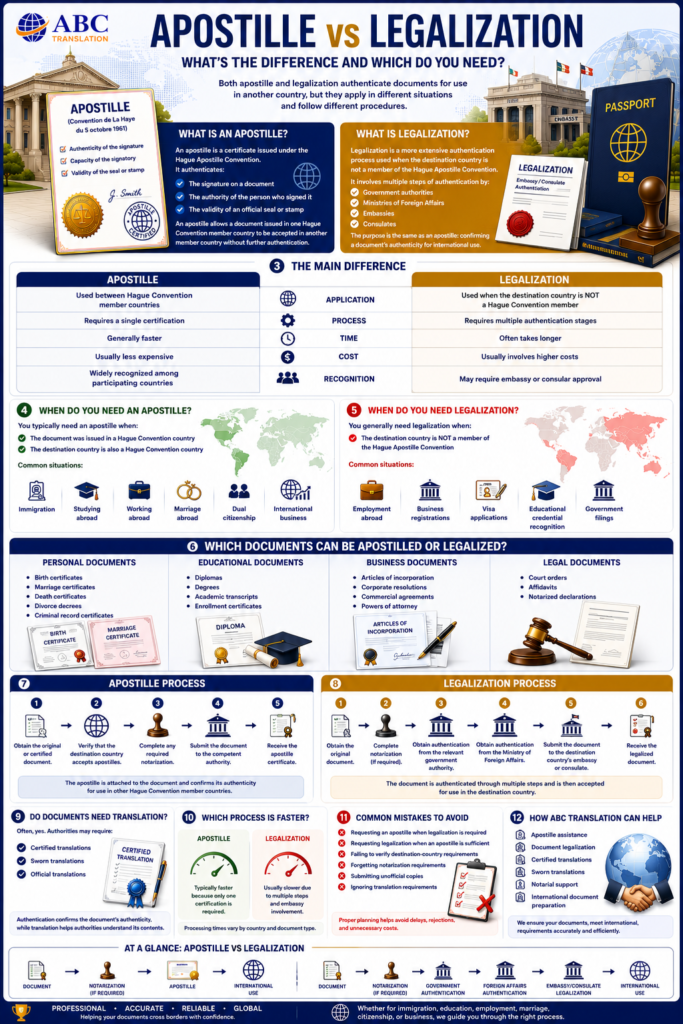
An apostille is a certificate issued under the Hague Apostille Convention.
It authenticates:
- The signature on a document
- The authority of the person who signed it
- The validity of an official seal or stamp
An apostille allows a document issued in one Hague Convention member country to be accepted in another member country without further authentication.
What Is Legalization?
Legalization is a more extensive authentication process used when the destination country is not a member of the Hague Apostille Convention.
Legalization often involves multiple steps, including authentication by:
- Government authorities
- Ministries of Foreign Affairs
- Embassies
- Consulates
The purpose is the same as an apostille: confirming a document’s authenticity for international use.
The Main Difference Between Apostille and Legalization
Apostille
- Used between Hague Convention member countries
- Requires a single certification
- Generally faster
- Usually less expensive
- Widely recognized among participating countries
Legalization
- Used when the destination country is not a Hague Convention member
- Requires multiple authentication stages
- Often takes longer
- Usually involves higher costs
- May require embassy or consular approval
When Do You Need an Apostille?
You typically need an apostille when:
- The document was issued in a Hague Convention country
- The destination country is also a Hague Convention country
Common situations include:
- Immigration
- Studying abroad
- Working abroad
- Marriage abroad
- Dual citizenship applications
- International business transactions
When Do You Need Legalization?
You generally need legalization when:
- The destination country is not a member of the Hague Apostille Convention
Common examples include:
- Employment abroad
- Business registrations
- Visa applications
- Educational credential recognition
- Government filings
Requirements vary depending on the destination country.
Which Documents Can Be Apostilled or Legalized?
Common documents include:
Personal Documents
- Birth certificates
- Marriage certificates
- Death certificates
- Divorce decrees
- Criminal record certificates
Educational Documents
- Diplomas
- Degrees
- Academic transcripts
- Enrollment certificates
Business Documents
- Articles of incorporation
- Corporate resolutions
- Commercial agreements
- Powers of attorney
Legal Documents
- Court orders
- Affidavits
- Notarized declarations
Apostille Process
The apostille process generally follows these steps:
Step 1
Obtain the original or certified document.
Step 2
Verify that the destination country accepts apostilles.
Step 3
Complete any required notarization.
Step 4
Submit the document to the competent authority.
Step 5
Receive the apostille certificate.
Legalization Process
The legalization process is often more complex.
Step 1
Obtain the original document.
Step 2
Complete notarization if required.
Step 3
Obtain authentication from the relevant government authority.
Step 4
Obtain authentication from the Ministry of Foreign Affairs.
Step 5
Submit the document to the destination country’s embassy or consulate.
Step 6
Receive the legalized document.
Do Apostilled or Legalized Documents Need Translation?
Often, yes.
Authorities may require:
- Certified translations
- Sworn translations
- Official translations
The authentication process confirms the document’s authenticity, while the translation allows foreign authorities to understand its contents.
Which Process Is Faster?
Apostille
Typically faster because only one certification is required.
Legalization
Usually slower due to multiple authentication stages and embassy involvement.
Processing times vary by country and document type.
Common Mistakes to Avoid
Many applicants experience delays because they:
- Request an apostille when legalization is required
- Request legalization when an apostille is sufficient
- Fail to verify destination-country requirements
- Forget notarization requirements
- Submit unofficial copies
- Ignore translation requirements
Proper planning helps avoid unnecessary delays.
Why Choose ABC Translation?
ABC Translation provides comprehensive support for both apostille and legalization procedures.
Our services include:
- Apostille assistance
- Document legalization
- Certified translations
- Sworn translations
- Notarial support
- International document preparation
Our experienced team helps ensure your documents meet the requirements of foreign authorities worldwide (Apostille vs Legalization).
Need Help Determining Whether You Need an Apostille or Legalization?
Whether your documents are intended for immigration, employment, education, marriage, citizenship, or international business, ABC Translation can help identify the correct authentication process and prepare your documents for international acceptance.
Contact ABC Translation for professional assistance with apostilles, legalization services, and certified translations.