Can a Notary Issue an Apostille?
One of the most common misconceptions about document authentication is (can a Notary Issue an Apostille?):
“Can a notary issue an apostille?”
The answer is:
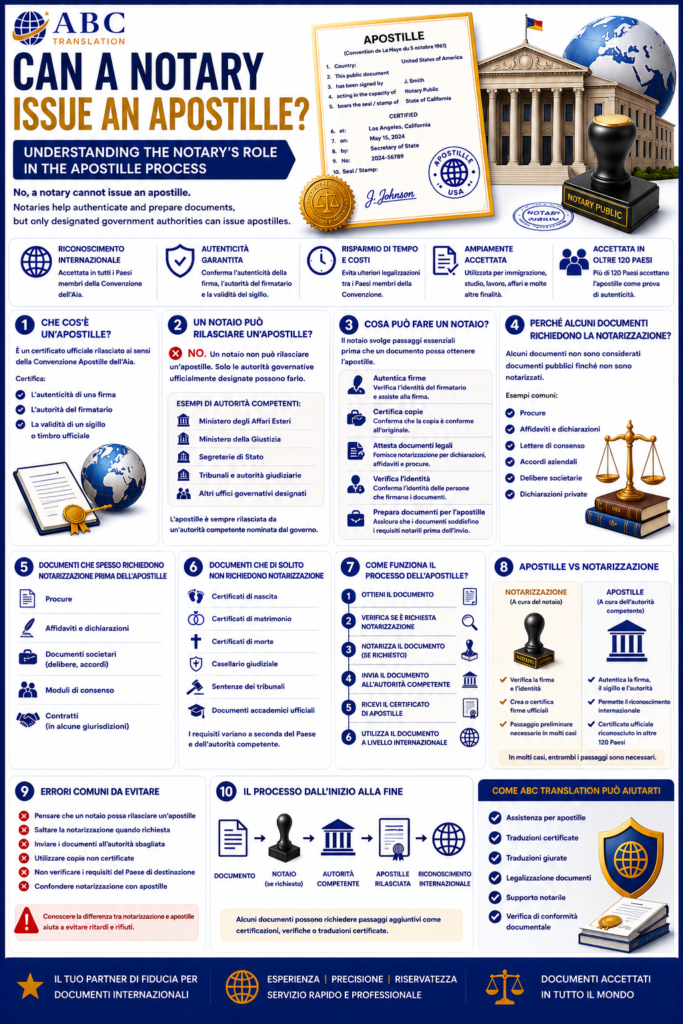
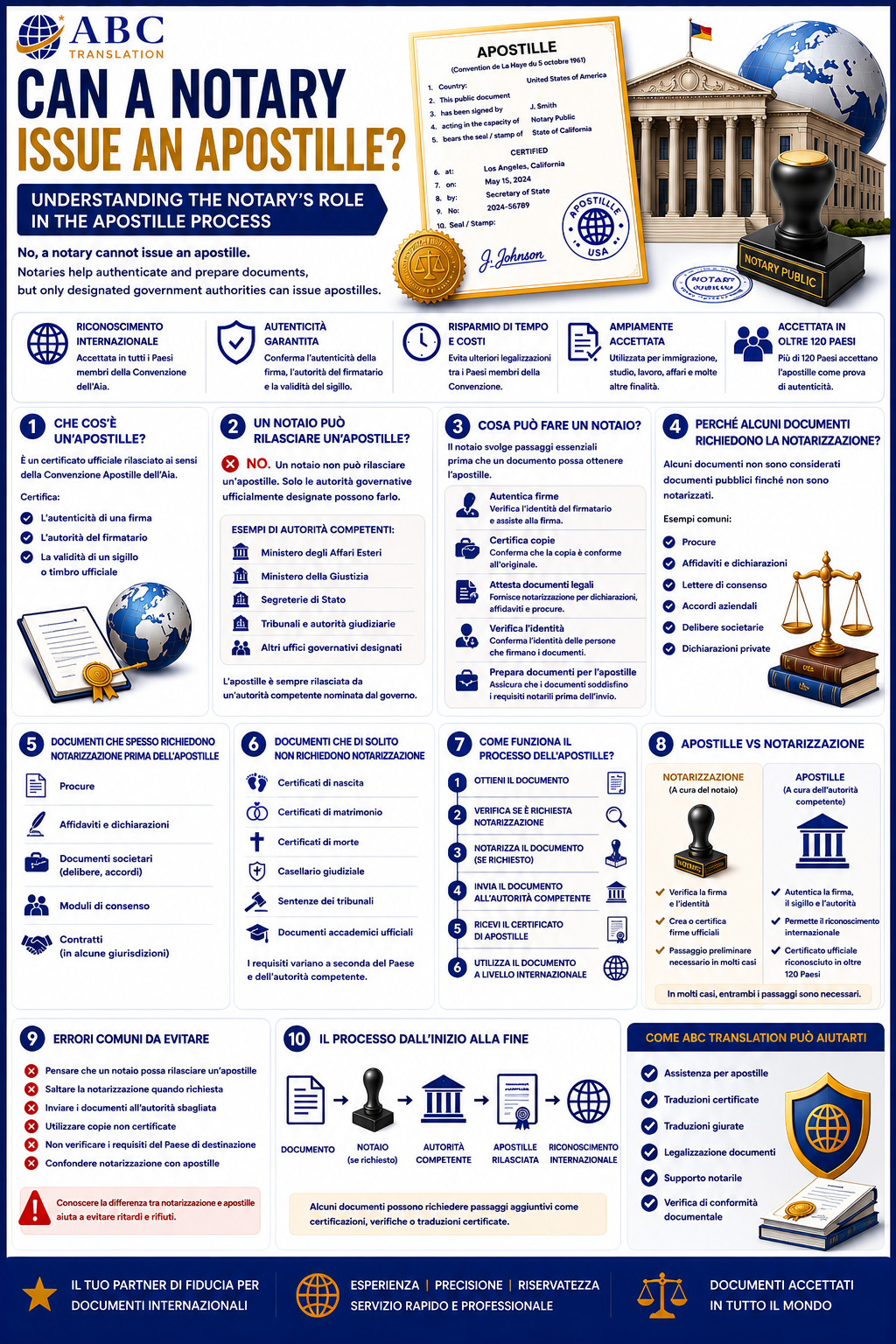
No, a notary cannot issue an apostille.
However, notaries often play an important role in the apostille process. Many documents must first be notarized before they can be submitted to the government authority responsible for issuing the apostille.
Understanding the difference between notarization and apostille issuance can help prevent delays, rejected applications, and unnecessary expenses.
ABC Translation assists individuals, businesses, law firms, and organizations with apostilles, certified translations, document legalization, and international document authentication.
What Is an Apostille?
An apostille is an official certificate issued under the Hague Apostille Convention.
It confirms:
- The authenticity of a signature
- The authority of the person signing the document
- The validity of an official seal or stamp
An apostille allows a document issued in one Hague Convention country to be recognized in another member country without additional legalization.
Can a Notary Issue an Apostille?
No.
A notary public does not have the authority to issue apostilles.
Only officially designated government authorities may issue apostilles.
Depending on the country, these authorities may include:
- Ministries of Foreign Affairs
- Ministries of Justice
- Secretaries of State
- Courts or judicial authorities
- Other designated government offices
The apostille is always issued by a competent authority appointed by the government.
What Can a Notary Do?
Although a notary cannot issue an apostille, they often perform essential steps before an apostille can be obtained.
A notary may:
Authenticate Signatures
Verify the identity of the signer and witness the signature.
Certify Copies
Confirm that a copy matches the original document.
Witness Legal Documents
Provide notarization for declarations, affidavits, and powers of attorney.
Verify Identity
Confirm the identity of individuals signing documents.
Prepare Documents for Apostille
Ensure documents meet notarization requirements before submission.
These services often form the first stage of the apostille process.
Why Do Some Documents Require Notarization?
Certain documents are not considered public documents until they have been notarized.
Examples include:
- Powers of attorney
- Affidavits
- Consent letters
- Business agreements
- Corporate resolutions
- Private declarations
In these cases, notarization creates the official signature that can later be authenticated through an apostille.
Which Documents Often Require Notarization Before Apostille?
Powers of Attorney
One of the most common examples requiring notarization.
Affidavits and Declarations
Typically must be notarized before apostille issuance.
Corporate Documents
Board resolutions and business agreements often require notarization.
Consent Forms
Frequently used for international travel and legal matters.
Contracts
Certain jurisdictions require notarization before apostille processing.
Which Documents Usually Do Not Require Notarization?
Many government-issued documents can often proceed directly to apostille issuance.
Examples include:
- Birth certificates
- Marriage certificates
- Death certificates
- Criminal record certificates
- Court judgments
- Government-issued academic records
Requirements vary by country and authority.
How Does the Apostille Process Work?
Step 1
Obtain the document.
Step 2
Determine whether notarization is required.
Step 3
If required, have the document notarized.
Step 4
Submit the document to the competent apostille authority.
Step 5
Receive the apostille certificate.
Step 6
Use the document internationally.
This process may vary depending on the document type and jurisdiction.
Apostille vs. Notarization
Many people confuse these two procedures.
Notarization
- Performed by a notary public
- Verifies signatures and identities
- Creates or certifies official signatures
Apostille
- Issued by a government authority
- Authenticates signatures and seals
- Enables international recognition
In many cases, both are required.
Common Mistakes to Avoid
Many applications are delayed because applicants:
- Assume a notary can issue an apostille
- Skip required notarization
- Submit documents to the wrong authority
- Use uncertified copies
- Fail to verify destination-country requirements
- Confuse notarization with apostille authentication
Understanding the difference helps avoid unnecessary delays.
Why Choose ABC Translation?
ABC Translation provides comprehensive support for international document preparation.
Our services include:
- Apostille assistance
- Certified translations
- Sworn translations
- Document legalization
- Notarial support
- International document compliance reviews
Our experienced team helps ensure documents are correctly prepared before submission for apostille issuance.
Need Help with Notarization and Apostilles?
Whether you need an apostille for a power of attorney, affidavit, business document, birth certificate, marriage certificate, diploma, or court record, ABC Translation can guide you through every step.
Contact ABC Translation for professional assistance with apostilles, certified translations, notarization support, and international document legalization.