Apostille Requirements Explained
If you plan to use official documents in another country, you may need an apostille (Apostille Requirements Explained).
However, many people are unsure about the specific requirements involved in obtaining one.
Understanding apostille requirements can help avoid delays, rejected applications, and costly mistakes when preparing documents for international use.
ABC Translation assists individuals, businesses, legal professionals, and international organizations with apostilles, certified translations, document legalization, and international document preparation.
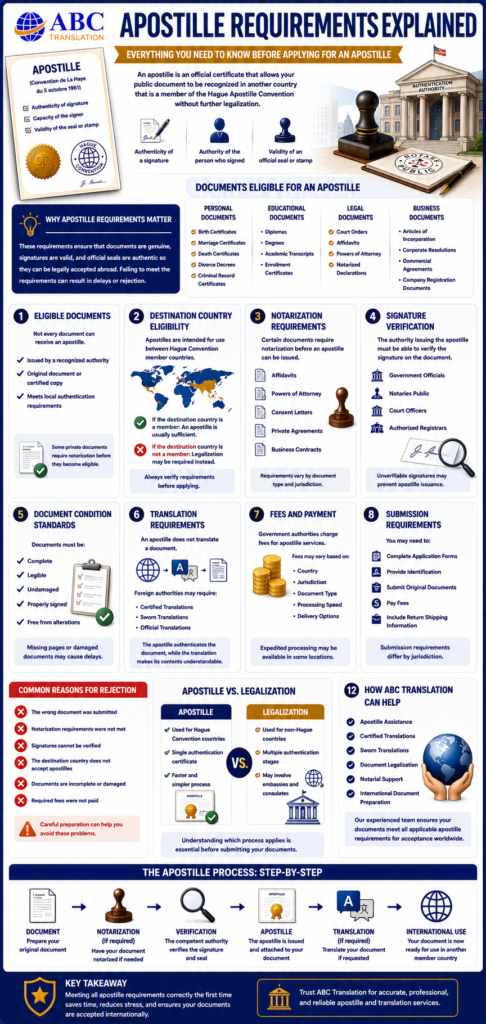
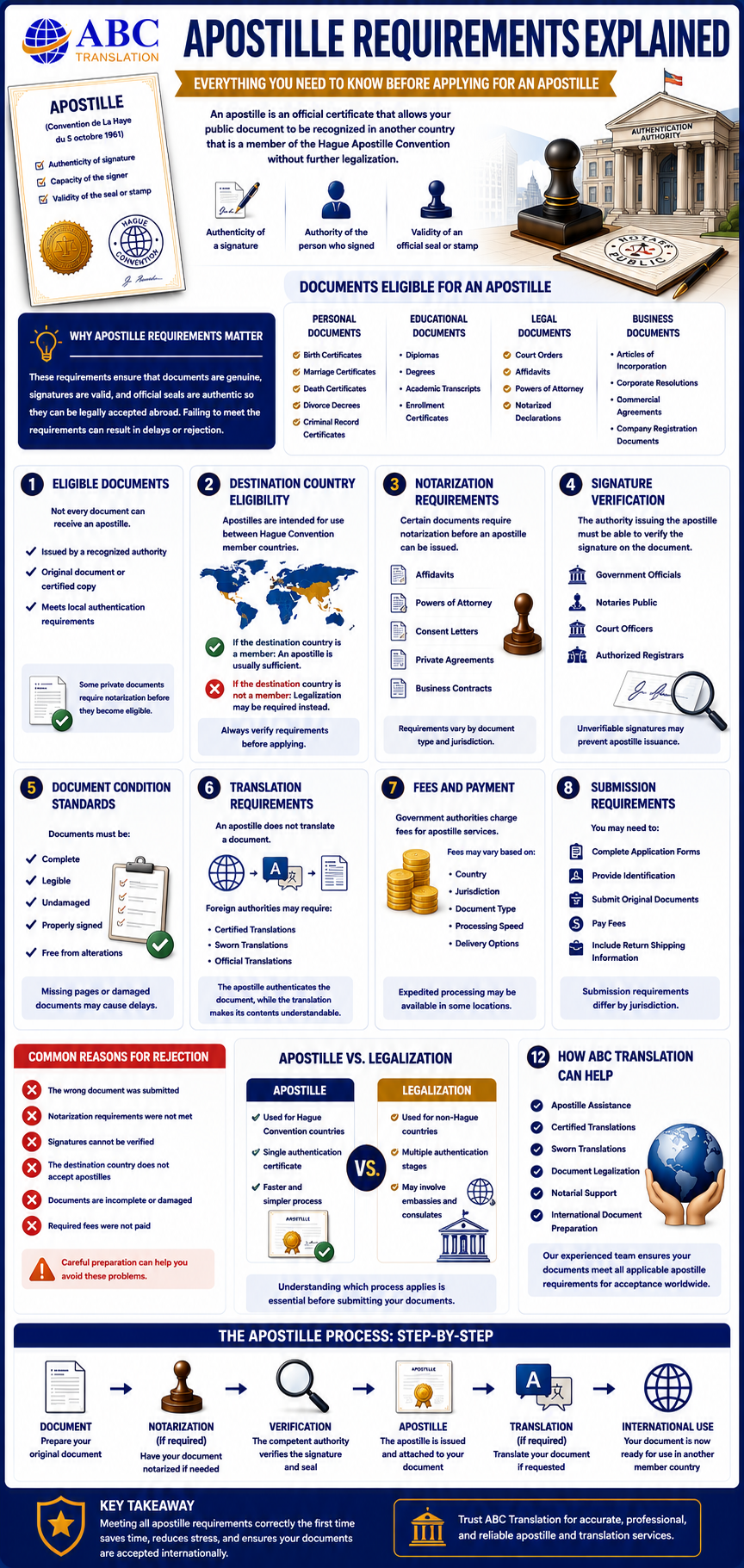
What Is an Apostille?
An apostille is an official certificate issued under the Hague Apostille Convention.
It verifies:
- The authenticity of a signature
- The authority of the person who signed the document
- The validity of an official seal or stamp
An apostille allows documents issued in one member country to be recognized in another Hague Convention member country without further legalization.
Why Are Apostille Requirements Important?
Government agencies, universities, employers, courts, and foreign authorities require assurance that foreign documents are authentic.
Apostille requirements exist to ensure:
- Documents are genuine
- Signatures are valid
- Official seals are authentic
- Documents can be legally accepted abroad
Failing to meet the requirements can result in delays or rejection.
Which Documents Qualify for an Apostille?
Common qualifying documents include:
Personal Documents
- Birth certificates
- Marriage certificates
- Death certificates
- Divorce decrees
- Criminal record certificates
Educational Documents
- Diplomas
- Degrees
- Academic transcripts
- Enrollment certificates
Legal Documents
- Court orders
- Affidavits
- Powers of attorney
- Notarized declarations
Business Documents
- Articles of incorporation
- Corporate resolutions
- Commercial agreements
- Company registration documents
Requirement 1: The Document Must Be Eligible
Not every document can receive an apostille.
Generally, documents must:
- Be issued by a recognized authority
- Be an original document or certified copy
- Meet local authentication requirements
Some private documents require notarization before they become eligible.
Requirement 2: The Destination Country Must Accept Apostilles
Apostilles are intended for use between countries that are members of the Hague Apostille Convention.
If the Destination Country Is a Member
An apostille is usually sufficient.
If the Destination Country Is Not a Member
Document legalization may be required instead.
Always verify destination-country requirements before applying.
Requirement 3: Notarization May Be Required
Certain documents require notarization before an apostille can be issued.
Examples include:
- Affidavits
- Powers of attorney
- Consent letters
- Private agreements
- Business contracts
Requirements vary depending on the document type and jurisdiction.
Requirement 4: Signatures Must Be Verifiable
The authority issuing the apostille must be able to verify the signature appearing on the document.
This may include signatures from:
- Government officials
- Notaries public
- Court officers
- Authorized registrars
Unverifiable signatures may prevent apostille issuance.
Requirement 5: The Document Must Be in Proper Condition
Many authorities require documents to be:
- Complete
- Legible
- Undamaged
- Properly signed
- Free from alterations
Missing pages or damaged documents may cause delays.
Requirement 6: Translation Requirements May Apply
An apostille does not translate a document.
Foreign authorities may require:
- Certified translations
- Sworn translations
- Official translations
The apostille authenticates the document, while the translation makes its contents understandable.
Requirement 7: Applicable Fees Must Be Paid
Government authorities usually charge fees for apostille services.
Costs may vary based on:
- Country
- Jurisdiction
- Document type
- Processing speed
- Delivery options
Expedited processing may be available in some locations.
Requirement 8: Correct Submission Procedures Must Be Followed
Applicants may need to:
- Complete application forms
- Provide identification
- Submit original documents
- Pay fees
- Include return shipping information
Submission requirements differ by jurisdiction.
Common Reasons Apostille Requests Are Rejected
Applications may be rejected because:
- The wrong document was submitted
- Notarization requirements were not met
- Signatures cannot be verified
- The destination country does not accept apostilles
- Documents are incomplete or damaged
- Required fees were not paid
Careful preparation can help avoid these problems.
Apostille vs. Legalization Requirements
Apostille
- Used for Hague Convention countries
- Single authentication certificate
- Faster and simpler process
Legalization
- Used for non-Hague countries
- Multiple authentication stages
- May involve embassies and consulates
Understanding which process applies is essential before submitting documents.
Why Choose ABC Translation?
ABC Translation provides comprehensive support for international document authentication.
Our services include:
- Apostille assistance
- Certified translations
- Sworn translations
- Document legalization
- Notarial support
- International document preparation
Our experienced team helps ensure your documents satisfy all applicable apostille requirements.
Need Help Understanding Apostille Requirements?
Whether your documents are intended for immigration, education, employment, marriage, citizenship, or international business, ABC Translation can help you identify the correct requirements and prepare your documents properly.
Contact ABC Translation for professional assistance with apostilles, certified translations, and international document authentication.