How to Obtain an Apostille
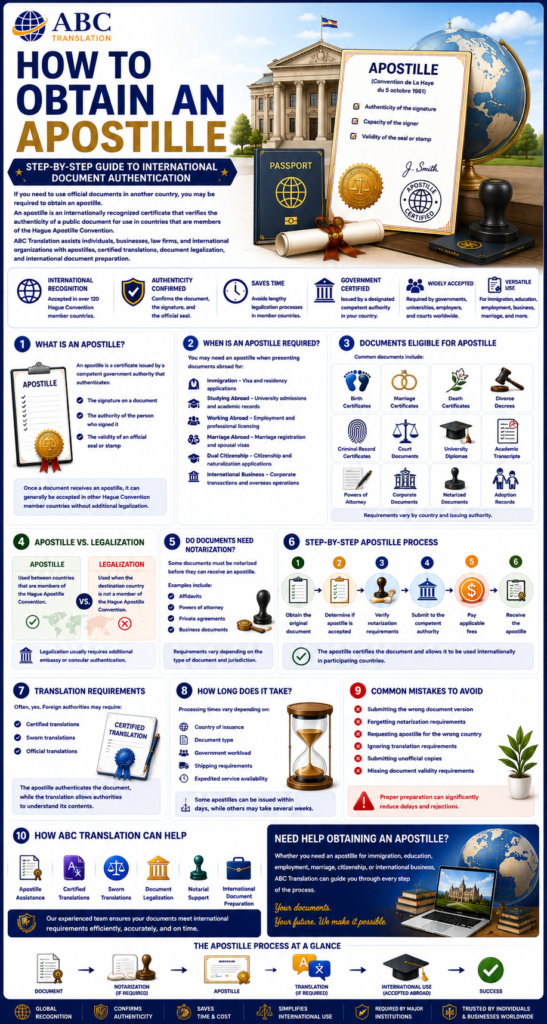
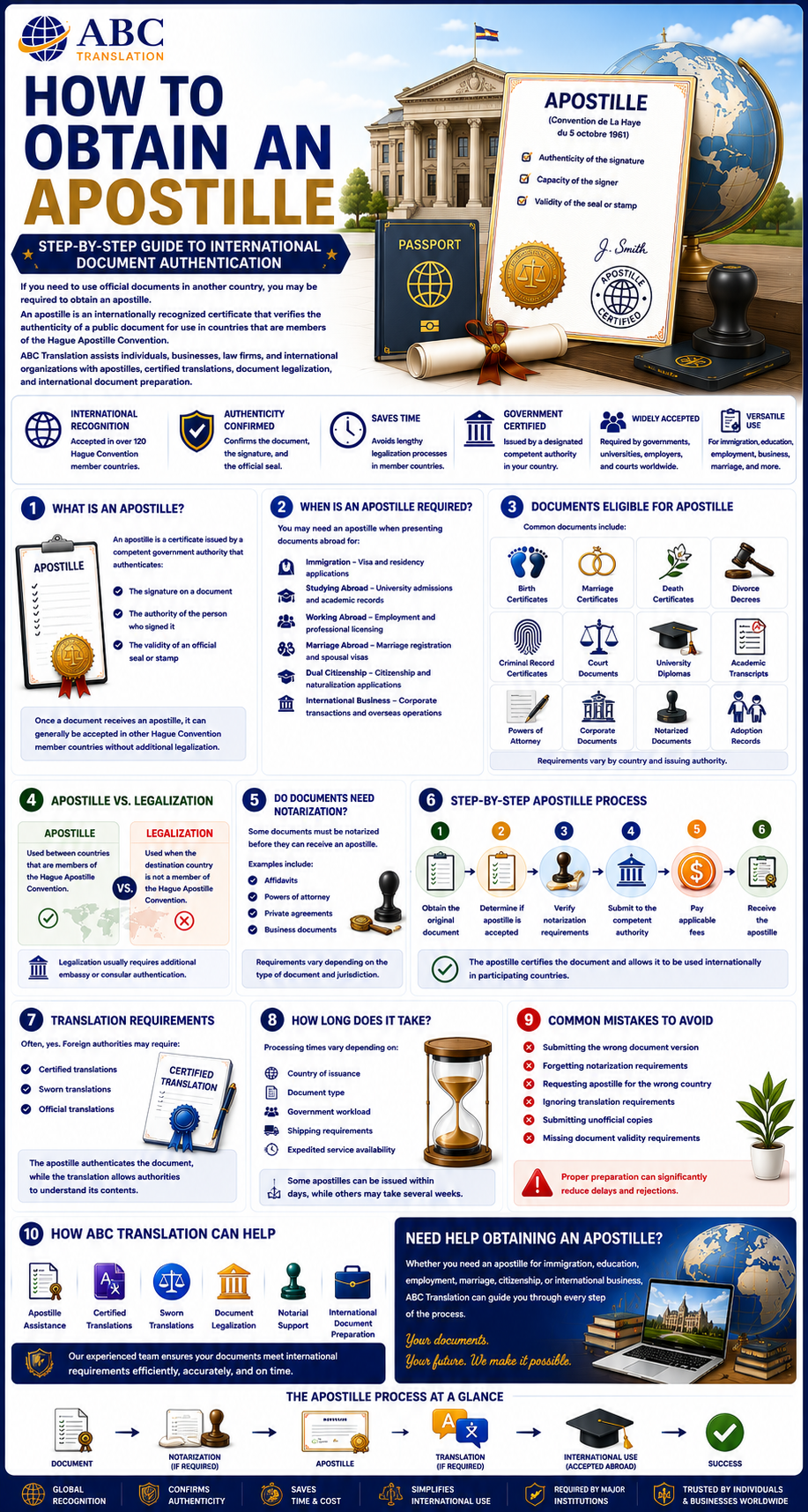
If you need to use official documents in another country, you may be required to obtain an apostille.
An apostille is an internationally recognized certificate that verifies the authenticity of a public document for use in countries that are members of the Hague Apostille Convention.
Understanding how to obtain an apostille can help avoid delays in immigration, education, employment, business, and legal matters abroad.
ABC Translation assists individuals, businesses, law firms, and international organizations with apostilles, certified translations, document legalization, and international document preparation.
What Is an Apostille?
An apostille is a certificate issued by a competent government authority that authenticates:
- The signature on a document
- The authority of the person who signed it
- The validity of an official seal or stamp
Once a document receives an apostille, it can generally be accepted in other Hague Convention member countries without additional legalization.
When Do You Need an Apostille?
You may need an apostille when presenting documents abroad for:
Immigration
Visa and residency applications often require apostilled documents.
Studying Abroad
Universities frequently request apostilled diplomas and transcripts.
Working Abroad
Employers and licensing authorities may require authenticated credentials.
Marriage Abroad
Marriage registration often requires apostilled civil documents.
Dual Citizenship Applications
Citizenship authorities frequently request apostilled records.
International Business
Companies may need apostilled corporate documents for overseas operations.
Which Documents Can Be Apostilled?
Common documents include:
- Birth certificates
- Marriage certificates
- Death certificates
- Divorce decrees
- Criminal record certificates
- Court documents
- University diplomas
- Academic transcripts
- Powers of attorney
- Corporate documents
- Notarized documents
- Adoption records
Requirements vary by country and issuing authority.
Step 1: Obtain the Original Document
Before requesting an apostille, obtain the correct version of the document.
In many cases, authorities require:
- Original documents
- Certified copies
- Recently issued records
Photocopies are often not accepted unless properly notarized.
Step 2: Determine Whether an Apostille Is Accepted
Verify whether the destination country is a member of the Hague Apostille Convention.
If the Country Is a Member
You typically need an apostille.
If the Country Is Not a Member
You may need document legalization instead of an apostille.
Step 3: Verify Notarization Requirements
Some documents must be notarized before they can receive an apostille.
Examples may include:
- Affidavits
- Powers of attorney
- Private agreements
- Business documents
Requirements vary depending on the document type and jurisdiction.
Step 4: Submit the Document to the Competent Authority
Apostilles are generally issued by designated government authorities such as:
- Secretaries of State
- Ministries of Foreign Affairs
- Courts
- Government authentication offices
The responsible authority depends on the country where the document was issued.
Step 5: Pay Applicable Fees
Most authorities charge an apostille fee.
Costs vary based on:
- Country
- Jurisdiction
- Processing speed
- Delivery method
Some locations offer expedited services for urgent requests.
Step 6: Receive the Apostille
Once approved, the authority attaches or issues the apostille certificate.
The apostille verifies the authenticity of the document and allows it to be used internationally in participating countries.
Do Apostilled Documents Need Translation?
Often, yes.
Foreign authorities may require:
- Certified translations
- Sworn translations
- Official translations
The apostille authenticates the document, while the translation allows authorities to understand its contents.
How Long Does It Take to Obtain an Apostille?
Processing times vary depending on:
- Country of issuance
- Document type
- Government workload
- Shipping requirements
- Expedited service availability
Some apostilles can be issued within days, while others may take several weeks.
Common Mistakes to Avoid
Many applications are delayed because applicants:
- Submit the wrong document version
- Forget notarization requirements
- Request an apostille for the wrong country
- Ignore translation requirements
- Submit unofficial copies
- Miss document validity requirements
Proper preparation can significantly reduce delays.
Apostille vs. Legalization
Apostille
Used between countries that are members of the Hague Apostille Convention.
Legalization
Used when the destination country is not a Convention member.
Legalization usually requires additional embassy or consular authentication.
Why Choose ABC Translation?
ABC Translation provides complete support for international document authentication.
Our services include:
- Apostille assistance
- Certified translations
- Sworn translations
- Document legalization
- Notarial support
- International document preparation
Our experienced team helps ensure your documents meet international requirements efficiently and accurately.
Need Help Obtaining an Apostille?
Whether you need an apostille for immigration, education, employment, marriage, citizenship, or international business, ABC Translation can guide you through every step of the process.
Contact ABC Translation for professional assistance with apostilles, certified translations, and international document authentication.