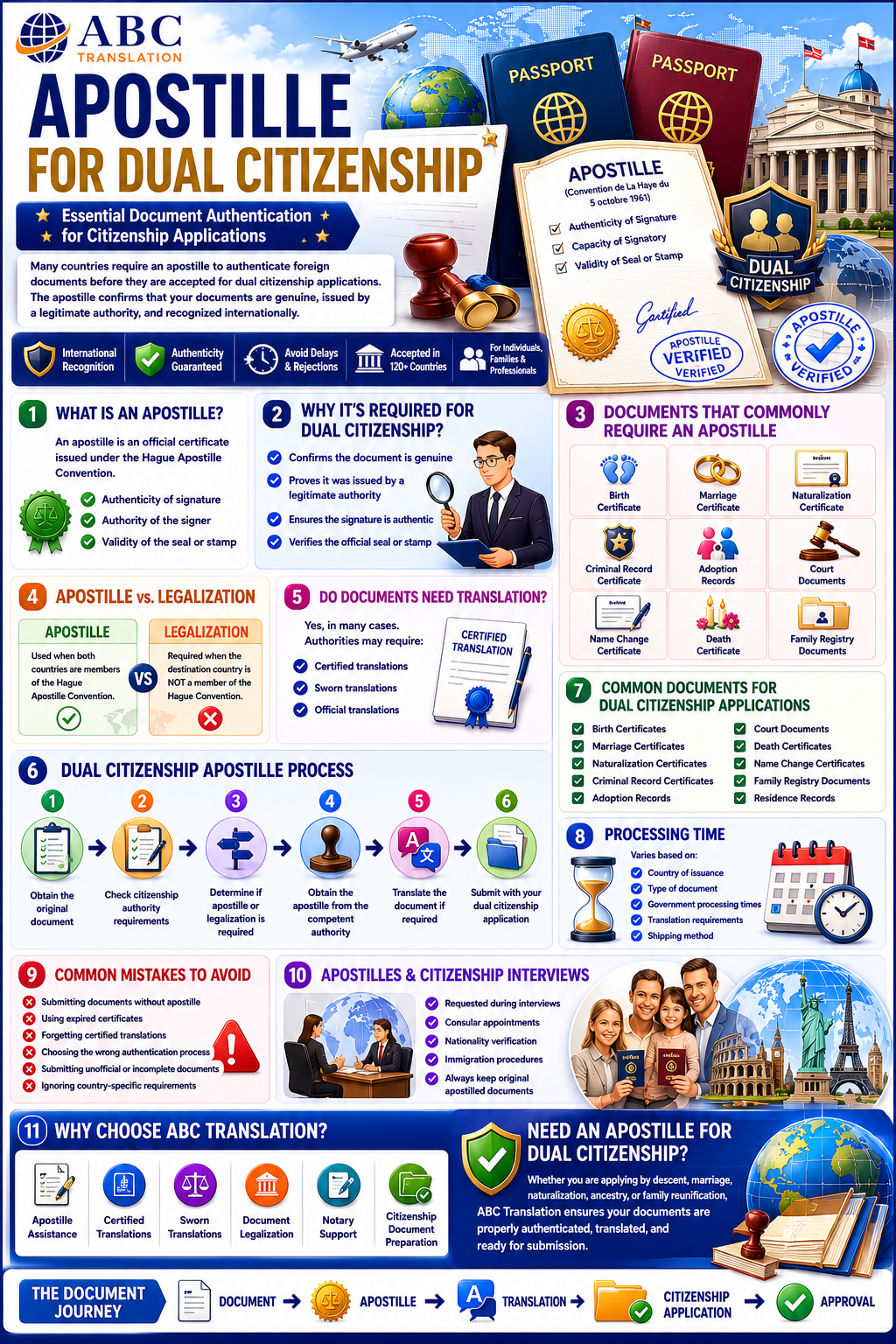
Apostille for Dual Citizenship
Applying for dual citizenship often requires submitting official documents issued in another country (Apostille for Dual Citizenship).
Citizenship authorities must verify that foreign documents are authentic before they can be accepted as part of the application process.
One of the most widely accepted methods of international document authentication is an apostille.
An apostille certifies the authenticity of a document and allows it to be recognized in countries that are members of the Hague Apostille Convention.
ABC Translation assists individuals, families, legal professionals, and citizenship applicants with apostilles, certified translations, document legalization, and international document preparation.
What Is an Apostille?
An apostille is an official certificate issued under the Hague Apostille Convention.
It verifies:
- The authenticity of a signature
- The authority of the person signing the document
- The validity of an official seal or stamp
The apostille enables documents issued in one member country to be legally recognized in another member country without additional legalization.
Why Is an Apostille Required for Dual Citizenship?
Citizenship authorities need to confirm that foreign documents are genuine and legally valid.
An apostille provides official proof that:
- The document was issued by a legitimate authority
- The signature is authentic
- The official seal is valid
Without proper authentication, citizenship applications may be delayed, rejected, or require additional verification procedures.
Which Documents Commonly Require an Apostille for Dual Citizenship?
Birth Certificates
One of the most frequently requested documents in citizenship applications.
Marriage Certificates
Often required to establish family relationships and eligibility.
Naturalization Certificates
May be needed to prove existing citizenship status.
Criminal Record Certificates
Frequently required to demonstrate good character and legal compliance.
Adoption Records
Necessary in certain family-based citizenship applications.
Court Documents
Used when citizenship eligibility depends on legal judgments or family matters.
Name Change Certificates
May be required when personal details differ across documents.
Do Citizenship Documents Need Translation?
In many cases, yes.
Citizenship authorities may require:
- Certified translations
- Sworn translations
- Official translations by qualified translators
Translation requirements vary by country and citizenship program.
Apostille vs. Legalization for Citizenship Applications
The correct authentication process depends on the destination country.
Apostille
Used when both countries are members of the Hague Apostille Convention.
Legalization
Required when the destination country is not a Hague Convention member.
Legalization generally involves additional embassy or consular authentication.
How Does the Apostille Process Work?
Step 1
Obtain the original official document.
Step 2
Confirm citizenship authority requirements.
Step 3
Determine whether an apostille or legalization is required.
Step 4
Submit the document to the competent apostille authority.
Step 5
Translate the document if required.
Step 6
Include the authenticated document with your citizenship application.
Common Documents Submitted for Dual Citizenship Applications
The most frequently requested documents include:
- Birth certificates
- Marriage certificates
- Death certificates
- Naturalization certificates
- Criminal record certificates
- Adoption records
- Court orders
- Family registry documents
- Name change certificates
- Residence records
How Long Does the Apostille Process Take?
Processing times vary depending on:
- Country of issuance
- Document type
- Government processing times
- Translation requirements
- Shipping and delivery methods
Some jurisdictions offer expedited apostille services.
Common Mistakes to Avoid
Many dual citizenship applications experience delays because applicants:
- Submit documents without apostilles
- Use expired records
- Forget certified translations
- Apply for the wrong authentication procedure
- Submit unofficial copies
- Fail to verify country-specific requirements
Proper preparation can significantly reduce processing delays.
Apostilles and Citizenship Interviews
Citizenship authorities may request original apostilled documents during:
- Citizenship interviews
- Consular appointments
- Nationality verification procedures
- Document review sessions
Applicants should retain original apostilled documents throughout the application process.
Why Choose ABC Translation?
ABC Translation provides comprehensive support for international citizenship documentation.
Our services include:
- Apostille assistance
- Certified translations
- Sworn translations
- Document legalization
- Notarial support
- Citizenship application document preparation
Our experienced team helps ensure your documents meet the requirements of citizenship authorities worldwide.
Need an Apostille for Dual Citizenship?
Whether you are applying for citizenship by descent, marriage, naturalization, ancestry, or family reunification, ABC Translation can help ensure your documents are correctly authenticated and ready for submission.
Contact ABC Translation for professional assistance with apostilles, certified translations, and dual citizenship documentation.