Translation Before or After Apostille?
One of the most common questions people ask when preparing documents for international use is: should the translation be completed before or after obtaining an apostille?
The answer depends on several factors, including the destination country, the type of document, and the requirements of the receiving authority. Choosing the wrong order can result in delays, additional costs, and rejected documents.
At ABC Translation, we regularly assist clients with certified translations, apostilles, and document legalization. Understanding the correct sequence can help ensure your documents are accepted the first time.
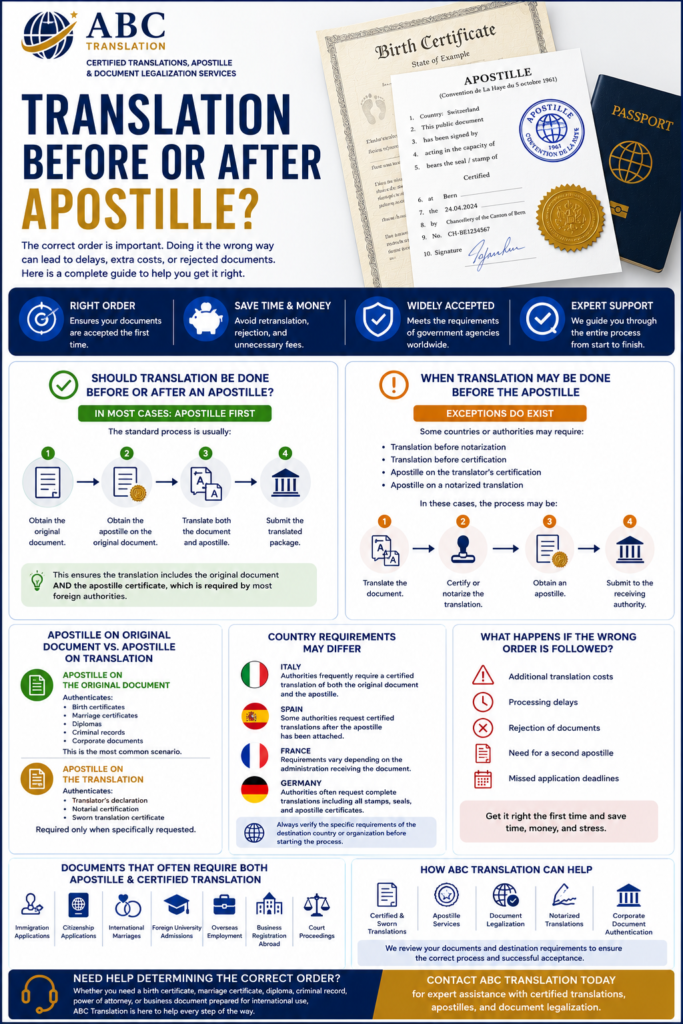
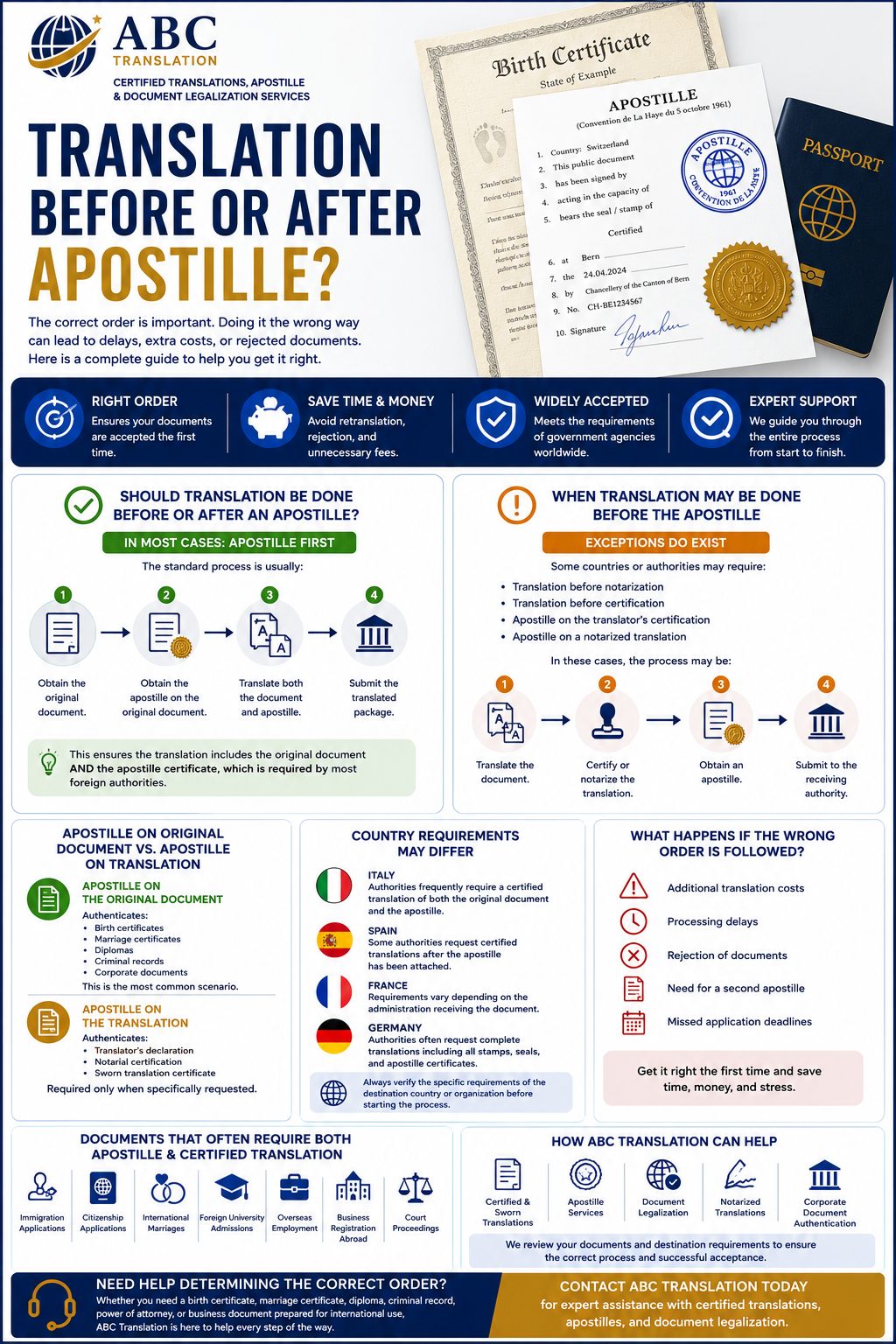
Should Translation Be Done Before or After an Apostille?
In most cases, the apostille should be obtained before the document is translated.
The standard process is usually:
- Obtain the original document.
- Obtain the apostille on the original document.
- Translate both the document and the apostille certificate.
- Submit the complete translated package to the foreign authority.
This approach allows the translator to translate not only the original document but also the apostille itself, ensuring that the receiving authority can understand all official certifications attached to the document.
Why Is Apostille Usually Obtained First?
The apostille becomes part of the official document package.
If the document is translated before obtaining the apostille, the apostille certificate will not appear in the translation. Many foreign authorities require a complete translation of all pages, including:
- The original document
- Apostille certificate
- Official stamps
- Seals
- Notarial endorsements
Obtaining the apostille first often prevents the need for a second translation later.
Common Example: Birth Certificate
Suppose you need to submit a birth certificate issued in Switzerland to authorities in Italy.
The recommended process is:
Step 1
Obtain the official birth certificate.
Step 2
Receive the apostille from the competent authority.
Step 3
Translate both the birth certificate and the apostille into Italian.
Step 4
Submit the translated documents to the Italian authority.
This ensures that the receiving authority can verify both the content of the certificate and the authenticity confirmed by the apostille.
When Should Translation Be Completed Before the Apostille?
There are some exceptions.
Certain countries or authorities may require:
- Translation before notarization.
- Translation before certification.
- Apostille on the translator’s certification.
- Apostille on a notarized translation.
In these situations, the process may be:
- Translate the document.
- Certify or notarize the translation.
- Obtain an apostille on the translator’s declaration or notarized translation.
This procedure is particularly common when the translation itself must be recognized as an official document.
Apostille on the Original Document vs. Apostille on the Translation
These are two very different procedures.
Apostille on the Original Document
The apostille authenticates:
- Birth certificates
- Marriage certificates
- Diplomas
- Criminal records
- Corporate documents
This is the most common scenario.
Apostille on the Translation
The apostille authenticates:
- Translator’s declaration
- Notarial certification
- Sworn translation certificate
This is required only when the receiving authority specifically requests it.
Country Requirements May Differ
Every country and institution may have different requirements regarding translations and apostilles.
For example:
Italy
Authorities frequently require a certified translation of both the original document and the apostille.
Spain
Some authorities request certified translations after the apostille has been attached.
France
Requirements vary depending on the administration receiving the document.
Germany
Authorities often request complete translations including all stamps, seals, and apostille certificates.
Because requirements vary, it is important to verify the specific rules before beginning the process.
What Happens if the Documents Are Prepared in the Wrong Order?
Preparing documents in the wrong sequence may result in:
- Additional translation costs
- Processing delays
- Rejection of documents
- Need for a second apostille
- Missed application deadlines
Professional guidance can help avoid these issues.
Certified Translation and Apostille Services
Many international procedures require both an apostille and a certified translation.
Examples include:
- Immigration applications
- Citizenship applications
- International marriages
- Foreign university admissions
- Overseas employment
- Business registration abroad
- Court proceedings
In these cases, ensuring the correct order is essential for successful document acceptance.
How ABC Translation Can Help
ABC Translation assists clients worldwide with:
- Certified translations
- Sworn translations
- Apostille services
- Document legalization
- Notarized translations
- Corporate document authentication
Our team reviews your destination country and document type to determine the correct procedure before any work begins.
Need Help Determining the Correct Order?
Whether you need a birth certificate, marriage certificate, diploma, criminal record, power of attorney, or business document prepared for international use, ABC Translation can guide you through the entire process.
Contact ABC Translation today for expert assistance with certified translations, apostilles, and document legalization to ensure your documents are accepted abroad without delays.